
Every prepackaged food in a Canadian grocery store carries a “Nutrition Facts” table by law, and as of January 1, 2026, many of them also carry a new black-and-white symbol on the front of the package. Between the table, the ingredient list, allergen declarations, and now the front-of-package symbol, there is more information on a box of crackers than most shoppers have time to read standing in the aisle. Knowing what to look at first, and what to ignore, turns that clutter into something usable in about ten seconds per product.
Start with Serving Size, Not the Numbers Below It

Everything on the Nutrition Facts label, from calories to sugar, fat and sodium, is expressed according to the serving size you’ll find at the top of the label. It is neither a suggestion of a person’s ideal serving size for food consumed at one sitting, nor a fact about what’s contained in one package. If a health agency, like Health Canada, frankly tells you to start by figuring out serving sizes relative to your consumption, it can only mean the rest of the Nutrition Facts label is ultimately meaningless.
Why This Trips People Up
A bag of chips might list a serving size of 12 chips, a portion most people blow past without noticing. If the label shows 150 calories and 10% DV sodium, but a real portion is closer to three servings, the actual sodium hit is closer to 30% DV. Recent updates to Canadian labelling regulations pushed serving sizes to better reflect what people typically eat in one sitting, which helps, but it’s still worth a glance before assuming the printed numbers apply to your actual portion.
Comparing Products Fairly
Two comparable food items like two different brands of soup would generally display comparable serving sizes, because the serving size within each group has already been standardized by Health Canada to provide consumers with direct comparables. If, however, one food item displays an unusually small number for the serving size compared to another similar item, it would be prudent to examine the nutrition facts carefully once again before concluding that the smaller numbers are indicative of a more healthy option.
Use the 5/15 Rule for % Daily Value
The % Daily Value (% DV) column tells you whether a serving has a little or a lot of a given nutrient, relative to recommended daily intake. Health Canada’s rule of thumb is that 5% DV or less counts as a little, and 15% DV or more counts as a lot. This applies to every nutrient with a % DV listed, from sodium to fibre.
Here are things to look for less of:
- Saturated and trans fat
- Sodium
- Sugars (there’s no official % DV target here, but total sugar grams are listed and worth comparing across products)
Things to look for more of:
- Fibre
- Potassium
- Calcium
- Iron
The table often lists 13 core nutrients in total, but for a quick in-aisle comparison between two similar products, checking % DV on sodium, fibre, and saturated fat covers most of what matters for everyday choices.
Using % DV to Compare, Not Just to Judge
The 5/15 rule works best as a comparison tool between similar products rather than a single-product pass/fail test. A jarred pasta sauce showing 20% DV sodium isn’t automatically a poor choice in isolation, but it is useful to know when standing next to a second jarred sauce showing 8% DV, especially if sodium is something you’re actively trying to manage. The % DV column turns a wall of unfamiliar numbers into something a shopper without a nutrition background can use in seconds.
The New Front-of-Package Symbol
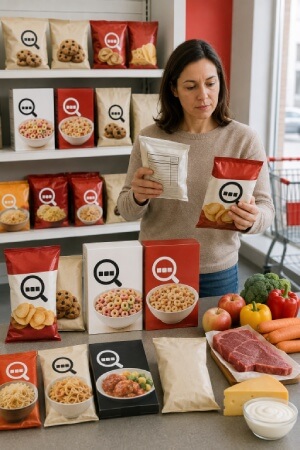
Consumers would need to spot a black magnified-glass icon sticker placed on the front of packaged foods, rather than be tucked inside the Nutrition Facts Table on the back, starting in 2026 for food high in saturated fat, sugar or sodium. Food would qualify for a front-of-package symbol sticker if it meets or exceeds 15 per cent of the Daily Value – defined by Health Canada- for saturated fat, sugar or sodium.
What the Symbol Does and Doesn’t Tell You
The symbol only indicates that a food is high in one or more of the three nutrients; it’s not a broad indicator of a healthy versus unhealthy product and it doesn’t look at all nutrients of concern. A food missing the symbol isn’t guaranteed to be healthy – it’s just that none of the three nutrients hit the target. And the symbol is designed to encourage further consultation of the whole Nutrition Facts panel – not to replace the label entirely.
Why It Exists Now
Health Canada officially enacted the legislation in 2022 as part of the government’s Healthy Eating Strategy and gave companies a several years-long phase in to adjust to packaging requirements. This phase-in closed at the end of last year and enforcement of the new rules has since been underway since January, 2026. If a product was packed according to old guidelines prior to Jan 1, a company can still sell off existing inventory until it is no longer available – this means consumers will continue to find both versions of a given product readily available for some time.
What Products Are Exempt
Some categories are exempt from the front-of-package symbol requirement even when they’d otherwise trigger it, including certain dairy products like plain cheese and yogurt, based on a lower calcium threshold that recognizes their nutritional role differently than typical packaged snack foods. Raw, single-ingredient foods like fresh meat, fruit, and vegetables generally don’t carry a Nutrition Facts table or the front-of-package symbol at all, since the requirement applies specifically to prepackaged, processed products.
Reading the Ingredient List
Ingredients are listed by weight, from most to least. Whatever is listed first makes up the largest proportion of the product, and by the third or fourth ingredient, you’re usually looking at minor components. A cereal that lists sugar, corn syrup, and a sugar variant like dextrose all in the first five ingredients is effectively sugar-forward, even if no single entry says sugar at the very top.
Spotting Sugar Under Different Names
Sugar shows up under dozens of names on Canadian labels: sucrose, glucose-fructose, dextrose, corn syrup, cane juice, honey, and more. Because Canadian regulations don’t require grouping these together in the ingredient list the way some other countries do, a product can list several sugar sources separately, each looking smaller individually, while the combined sugar content is significant. The total sugar figure in the Nutrition Facts table is a more reliable check than scanning names in the ingredient list.
Understanding Allergen Labelling
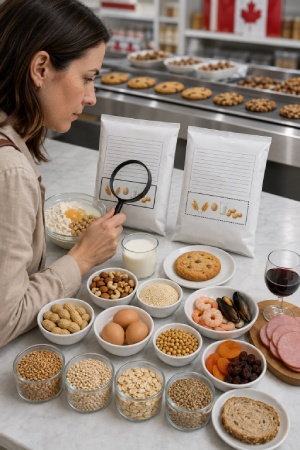
Beyond nutrition, Canadian food labels carry a separate and strictly regulated layer of allergen information, which matters even to shoppers without allergies, since it affects how ingredient lists are formatted and what may contain statements actually mean.
The Ten Priority Allergens
Health Canada and the CFIA jointly identify ten priority allergens responsible for the large majority of severe allergic reactions in Canada: peanuts, tree nuts, sesame seeds, milk, eggs, fish, crustaceans and molluscs, soy, wheat or triticale, mustard, and sulphites.
Gluten sources such as barley, oats, rye, triticale, and wheat, get the same enhanced labelling treatment even though gluten itself isn’t classified as an allergen, because of how significantly it affects people with celiac disease and gluten sensitivities.
Contains vs. May Contain
These two statements mean different things, and mixing them up matters if you or someone you’re shopping for has a food allergy. A “Contains” statement is a regulatory declaration required when a priority allergen is intentionally part of the product or an ingredient’s component; it must list every priority allergen present, even ones already named earlier in the ingredient list.
A “May Contain” statement is precautionary, flagging that the allergen could be present through shared equipment or cross-contact during manufacturing, even though it isn’t a deliberate ingredient. Both appear immediately after the ingredient list when used, and priority allergens must be declared using specific, standardized source names like wheat or egg rather than technical or scientific ingredient names that might obscure what’s actually in the product.
About Sulphites Specifically
Sulphites are a food additive rather than a true allergen in the strict sense, but sulphite-sensitive individuals can have allergy-like reactions including breathing difficulty, which is why the CFIA requires them to be declared once they reach 10 parts per million in a product. Common sources include wine, dried fruit, and some processed meats, categories where sulphites aren’t always the first thing a shopper would expect to check for.
Common Label Claims and What They Actually Require
Terms like low sodium, reduced sugar, and source of fibre aren’t just for marketing. They are actually regulated claims tied to specific thresholds in Health Canada’s Table of Permitted Nutrient Content Statements and Claims, updated alongside the 2026 labelling changes. A product can only carry a claim if it meets the defined cutoff for that nutrient. That said, a product flagged with the front-of-package symbol for a given nutrient generally can’t carry a positive claim about that same nutrient, so you won’t see a symbol for high sodium next to a low sodium claim on the same package.
Here are some claims worth trusting when you see them:
- Low in sodium or low in sugar: tied to a defined maximum threshold
- Source of fibre or high source of fibre: tied to a minimum gram threshold per serving
- No added sugar: means no sugar was added during processing, though the food may still contain naturally occurring sugar
Claims That Deserve a Second Look
Words like natural, made with real fruit, or artisanal aren’t tied to the same kind of regulated nutrient thresholds and can appear on products that are otherwise unremarkable nutritionally. These terms describe something about sourcing or process, not the nutrition profile, so they are worth checking against the actual Nutrition Facts table rather than taking it at face value.
Country of Origin and Product of Canada Claims
Origin claims like Product of Canada and Made in Canada are also regulated, though the requirements differ between them. Product of Canada generally requires that virtually all significant ingredients, processing, and labour involved are Canadian, while Made in Canada allows for a portion of imported ingredients as long as the last substantial transformation of the product happened domestically, along with a qualifying statement to that effect.
For shoppers specifically prioritizing Canadian-grown or Canadian-made food, the distinction between these two phrases is worth knowing rather than assuming they mean the same thing.
Reading Labels for Kids and Specific Diets
The same thing goes for someone who is Shopping for their children, or are responsible for a special dietary requirement for their family. For example, if my family needs to follow our daughter’s specific allergy as indicated by labels, then allergen labelling for me comes before serving size and percent Daily Value, as the smallest trace amount is much more significant to me than its overall value for nutrition. If it is a household and a concerned parent wants to cut down on their child’s sodium intake (as one example), then afront panel symbol might be viewed before getting to the table to save reading time – especially in Canadian labeling format where there is no distinction for children, and the base is an ‘adult’ reference diet of 2,000 calorie per day.
What Changed Recently, and What Didn’t
It may also be helpful to state explicitly what is new and what has been around for ages, as it’s not unreasonable to believe that many consumers thought the entire system just updated simultaneously.
The only real innovation on this package are the front of package symbol, and its twin: the updated Table of Permitted Nutrient Content Statements and Claims, which became effective simultaneously.
The very foundation of the label, the size of a serving and each serving’s percentage Daily Value, ingredients listed by weight, and a declaration of all allergens (including what the product “Contains,” have all been in effect for quite a long time. They’re not new; they’re sometimes grouped with the front of package symbol.
This may be helpful in clarifying that it is only a portion of the label that has been replaced, and hence some products continue to have their standard look-but for the fact that they now also possess a small black symbol on their front panel.
A Ten-Second Routine
Standing in a grocery aisle, a workable routine looks like this:
- Check the serving size
- Glance at the front-of-package symbol if there is one
- Scan % DV for sodium and fibre
- Skim the first few ingredients
- Check the allergen statement if it’s relevant to your household.
Putting the Whole Label Together
No one element of a food label, taken alone, holds the truth. A product with a sparkling ingredient statement can be swimming in sodium; one without a front-of-package symbol is not necessarily the healthiest in that category if the warning was for, say, sugar but you generally avoid foods low in sugar anyway. Reading a label effectively is reading the Nutrition Facts, ingredient statement, allergen declaration, and front-of-package symbol as four different but important windows to nutritional data, rather than trying to extract a single score of good or bad from a food. After that habit develops, you’ll stop seeing the back of food packaging as a monolithic slab of numbers and the front-of-package symbol as its ultimate judge and jury.